Institutional Value Realization Model (IVRM)
Most institutions do not lack strategy. They lack a coherent mechanism for governing value realization.
IVRM is an institutional management standard for governing capabilities as value-producing assets through a repeatable management mechanism. It is designed for institutional adoption and ongoing operation rather than as a one-off assessment, a generic framework, or a transformation method.
Where IVRM sits
IVRM sits between strategic intent, governance, transformation, and performance review. Strategy sets direction. Governance establishes accountability and decision authority. Transformation mobilizes change. Performance systems measure outcomes. IVRM provides the management mechanism that connects capability condition, intervention, and realized value across these elements.
The figure below shows where IVRM sits in relation to adjacent management domains and why it should be understood as a connecting institutional mechanism rather than a replacement for them.
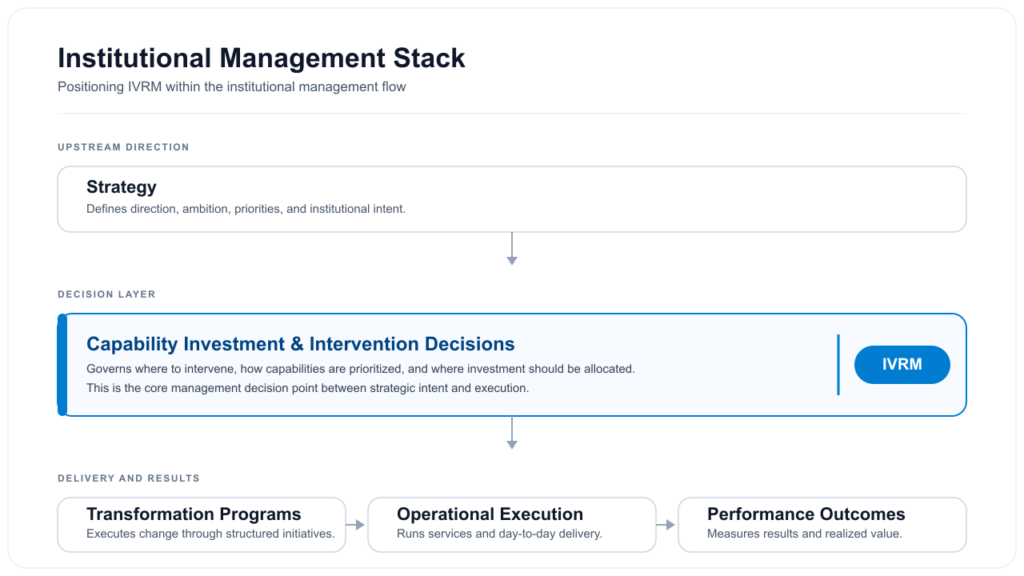
In this position, IVRM links strategic direction to capability-based intervention and realized value, while remaining distinct from strategy formulation, transformation execution, and performance reporting.
It does not replace strategy, governance, transformation, or performance management. It gives institutions a coherent capability-based logic for deciding where intervention is required, how action should be prioritized, and whether intended value is actually being realized over time.
Why IVRM exists
Many institutions have strategic intent, governance structures, transformation programs, and performance systems, but still lack a coherent management mechanism for governing capabilities as value-producing assets. As a result, capability condition, intervention, and realized value remain weakly linked. IVRM addresses that institutional gap and provides a more disciplined logic for value realization.
Why IVRM is distinct
Existing approaches are useful but partial. Maturity models assess condition. Capability maps structure understanding. Governance frameworks define accountability. Transformation methods mobilize change. Performance systems measure outcomes. What is often missing is a coherent institutional mechanism that connects these into one capability-based management logic. IVRM is designed to provide that mechanism.
IVRM Minimum Demonstrable Package
A valid IVRM operating form requires a minimum institutional chain consisting of capability definition and ownership, capability condition assessment, capability monitoring signals, capability dependency mapping, capability intervention prioritization, capability portfolio review, and value realization tracking. This is the IVRM Minimum Demonstrable Package. See also the How IVRM Works page for the operating logic.
- Define capabilities and assign ownership
- Assess capability condition
- Monitor capability signals
- Map capability dependencies
- Prioritize interventions
- Review the capability portfolio
- Track realized value
Publications
IVRM is supported by formal reference publications, including the IVRM Whitepaper, the Core Operating Logic, and sector-specific profiles. Together, these materials form the canonical public reference base for the model. See the Publications page.
Adoption
Organizations may adopt and operate IVRM internally. DUNNIXER is the originating steward of the model and may support institutional adoption and interpretation while preserving the integrity of the public standard. See the Adoption or Contact pages.